
MUSA
On the occasion of the XXV Milano Cortina 2026 Winter Olympic Games, scheduled from 6 to 22 February, CONI – the Italian National Olympic Committee – will be present in the Olympic locations of Milan, Cortina d’Ampezzo and Livigno with Casa Italia, a welcoming space and a privileged gateway to the country’s excellence.
Traditionally the athletes’ home and the beating heart of sporting celebrations, Casa Italia will open to the public for the first time, becoming a place of encounter and sharing dedicated to telling the story of Olympic Italy and sport through culture, innovation and tradition, giving life to an integrated system of spaces and content: an immersive journey that accompanies visitors into the heart of the Games, showcasing on the international stage the cultural, artistic and human heritage of our country through art, architecture, design and food.
For this extraordinary appointment, CONI has chosen the theme MUSA for Casa Italia Milano Cortina 2026: a tribute to the inspiring role Italy has played for centuries in the world’s imagination and culture, a call to the beauty, history and creativity that make Italy a global point of reference.
In the classical tradition, the Muses safeguard memory, nourish knowledge and transform thought into harmony through the arts: symbols of creative intuition and learning, they embody an inspiration that travels through time and generates vision. Italy – defined by unique biodiversity, by landscapes that ideally span the world’s North and South, and by a millennia-old history that blends cultures, languages and traditions – continues to influence travellers, artists and thinkers, presenting itself as an ideal place to welcome and enhance diversity, one of the founding values of the International Olympic Committee. In this sense, Casa Italia adopts MUSA as an interpretative key through which to present Italy, positioning itself as a narrative space capable of conveying the country’s geographical, cultural and social complexity.
MUSA is the culmination of a process launched in 2016, which has gradually transformed Casa Italia from a simple Hospitality House into a cultural project of international standing, able to tell the story of Italian culture and the “Sistema Paese” through its artistic, design and value-driven excellence. Edition after edition, Casa Italia has established itself as a representational space where sport, art, design and architecture can engage in organic dialogue: in Rio 2016, with Horizontal, it introduced the theme of cross-pollination between cultures, highlighting the encounter between different identities in a global context; in PyeongChang 2018, with Prospectum, it reflected on the Italian point of view in the dialogue between civilisations, placing at its centre the ability to observe, interpret and build relationships. In Tokyo 2020, with Mirabilia, it celebrated wonder as a hallmark of Italian craftsmanship and know-how, while in Beijing 2022, Millium developed the theme of travel as a metaphor for growth, transformation and cultural passage. Finally, in Paris 2024, with Ensemble, it placed harmony and dialogue between languages, disciplines and people at the forefront, interpreting the Olympic spirit as a collective and choral experience.
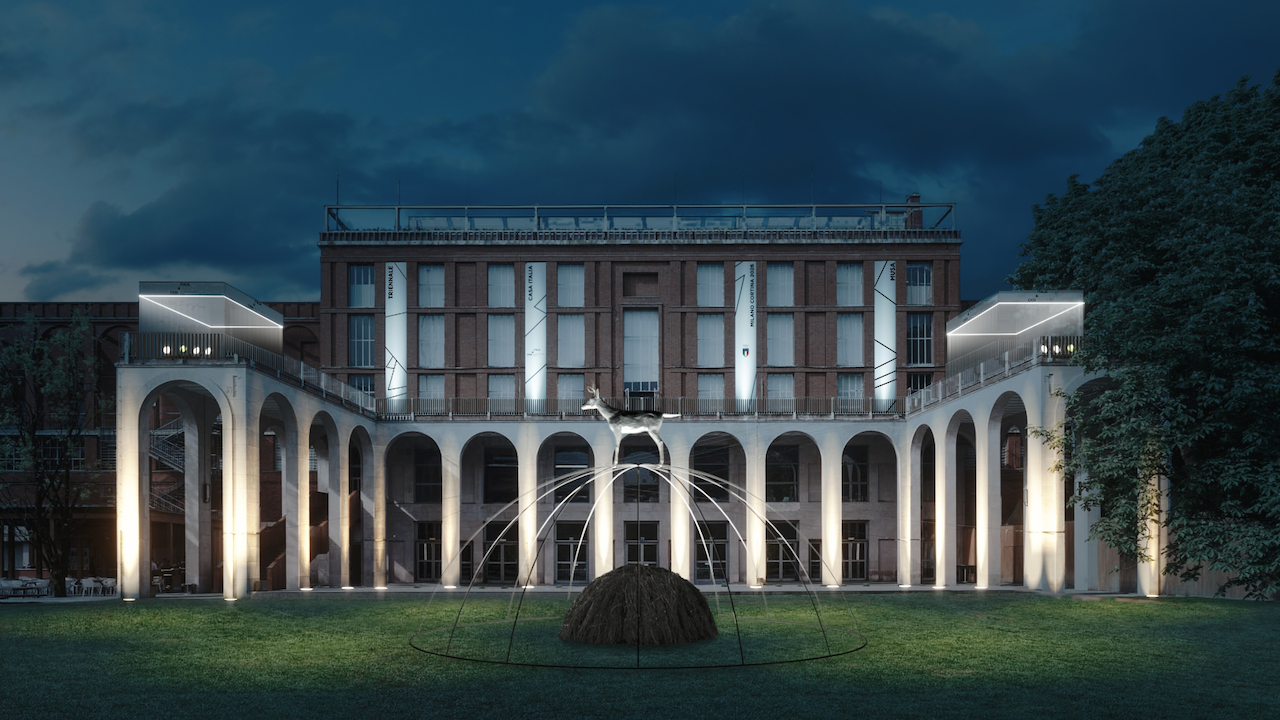
With Milano Cortina 2026, Casa Italia comes home to Italy and, with MUSA, represents the consolidation of a decade-long journey that strengthens its role as a cultural and institutional platform, complementary to sport and projected onto an international dimension. It unfolds as a single project across three venues — Triennale Milano, the Aquagranda Livigno Olympic Preparation Centre and Farsettiarte in Cortina d’Ampezzo — creating scenic, emotional routes in deep dialogue with one another.
Within the spaces, fully-fledged exhibition projects feature works by Claudio Abate, Camilla Alberti, Juan Araujo, Arman, John Armleder, Pablo Atchugarry, Atelier dell'Errore, Matteo Attruia, Giacomo Balla, Per Barclay, Giulio Bensasson, Ruth Beraha, Jessie Boswell, Fernando Botero, Stefano Cerio, Massimo Campigli, Luca Campigotto, Mario Ceroli, César, Christo and Jeanne-Claude, Giorgio De Chirico, Filippo de Pisis, Tristano di Robilant, Binta Diaw, Ifeyinwa Joy Chiamonwu, Elmgreen & Dragset, Slawomir Elsner, Bekhbaatar Enkhtur, Elger Esser, Chung Eun-Mo, Jean Fautrier, Gelitin, Piero Gemelli, John Giorno, Itamar Gov, Wang Haiyang, Keith Haring & L.A. II, James Hillman, Craigie Horsfield, Bryan Hunt, Carlos Idun-Tawiah, JR, Hayv Kahraman, William Kentridge, Jiri Kölar, Joseph Kosuth, Jannis Kounellis, Susanne Kutter, Sol LeWitt, Miltos Manetas, Roberto Sebastian Antonio Matta Echaurren, Giulia Mangoni, Gerhard Merz, Mario Merz, Jonathan Monk, Davide Monteleone, Vik Muniz, Shirin Neshat, Hermann Nitsch, Denis Oppenheim, Adrian Paci, Park Eun Sun, Yan Pei-Ming, Alejandra Varela Perera, Alessandro Piangiamore, Laura Pugno, Robert Rauschenberg, Davide Rivalta, Ugo Rondinone, Ottone Rosai, Anri Sala, Eva Sajovic, Mario Schifano, Daniel Spoerri, Thomas Struth, Hiroshi Sugimoto, Newsha Tavakolian, David Tremlett, Lihi Turjeman, Tursic & Mille, Cy Twombly, Ben Vautier, Ai Weiwei, Uwe Wittwer and Sislej Xhafa.
At every Casa Italia venue, the entrance is marked by a portal clad in reflective aluminium panels, a symbolic connective element that defines a single shared route. Alongside this architectural threshold is a work by John Giorno, conceived as a poetic and visual gateway. In Milan and Livigno, it is We Gave a Party for the Gods and the Gods All Came (2026), a wall painting that reflects the artist’s research into language as a visual, poetic and spiritual experience: painted words, turned into a space to be crossed, do not impose a single meaning but invite free interpretation and participation. In Cortina d’Ampezzo, another work by Giorno, Abbiamo dato una festa per gli Dei e tutti gli Dei sono venuti, engages with Casa Italia as a place of plurality, able to welcome different presences without hierarchy, within a shared dimension in which art asserts itself as a collective experience.
Pierre de Coubertin – father of the modern Olympic Games and founder of the International Olympic Committee (IOC) – had already conceived sport in close relation with art, reviving the model of ancient Greece. From the Stockholm Olympics of 1912 to those of London 1948, artists competed alongside athletes, and later artistic participation evolved into the organisation of exhibitions. Even today, Olympic Opening Ceremonies represent a form of performing art capable of conveying the universality of the Olympic message and some of humanity’s highest values.
CASA ITALIA IN MILAN
At Triennale Milano, the exhibition route is organised into nine sections, each dedicated to the inspiring muse of a discipline: language, architecture, visual arts, landscape, taste, music, dramatic art, innovation and sport. Each muse is represented by an iconic Olympic object from the Olympic Museum, underscoring that the values expressed are shared and promoted by the Olympic Movement.
At the entrance, the neon artwork Welcome by Matteo Attruia greets visitors, celebrating hospitality and welcome, defining values of Casa Italia since its foundation (Los Angeles, 1984). In the corridor, a suspended sculpture by Brian Hunt Re symbolises the breath of the Muses that can ignite creativity and the drive towards extraordinary feats. Finally, Claudio Abate’s photographic portraits document the passage through Italy of international artists Marina Abramović, Joseph Beuys, Joan Jonas, Gilbert & George, Roy Lichtenstein, Jean Tinguely and Robert Smithson.
With Calliope, muse of words and storytelling, Italy is revealed through texts, images and signs. Olympic pictograms, in use since Tokyo 1964, bear witness to the attempt to build a universal language, while works by Juan Araujo, Tristano di Robilant, Matta Echaurren, John Giorno, Joseph Kosuth, Susan Kutter, Ugo Rondinone, Cy Twombly and Ben Vautier intertwine word and vision in a plural narrative of our country.
The section dedicated to Clio, muse of memory and fame, explores architecture as a lasting trace of human gesture. The model of Pier Luigi Nervi’s Palazzetto dello Sport, made for the Rome 1960 Olympics and from the Olympic Museum collection, enters into dialogue with works by artists including Christo and Jeanne Claude, Chung Eun-Mo, Itamar Gov, Sol LeWitt, Vik Muniz, Denis Oppenheim, Yan Pei-Ming, Thomas Struth, Hiroshi Sugimoto, David Tremlett and Lihi Turjeman, composing a story in which built space becomes an archive of emotions and visions.
With Polyhymnia, muse of sacred poetry, pantomime, rhetoric, dance and memory, the exhibition opens out onto the Italian territory and its biodiversity. The hand-drawn Japanese animated short film Tomorrow’s Leaves, created in 2021 for the Tokyo 2020 Olympics, introduces a reflection on the relationship between humanity and nature. Works by Camilla Alberti, Giulio Bensasson, Ruth Beraha, Jessie Boswell, Fernando Botero, Binta Diaw, Elmgreen&Dragset, Bekhbaatar Enkhtur, Elger Esser, Keith Haring & L.A. II, JR, Gerhard Merz and Sislej Xhafa convey the complexity, fragility and richness of contemporary landscapes. This section also features the winning works of the Premio CONAI Arte Circolare, which highlight the value of sustainability.
Thalia, muse of celebration, presents Italy as a place of encounter, exchange and transformation. Pierre de Coubertin’s founding speech of 25 November 1892, Le Rétablissement des Jeux Olympiques – Discours fondateur, provides a counterpoint to works by Ai Weiwei, Per Barclay, Ifeyinwa Joy Chiamonwu, Slawomir Elsner, Gelitin, Jonathan Monk, Park Eun Sun, Eva Sajovic, Anri Sala, Thomas Struth and Uwe Wittwer, which examine the social body, collective memory and the meaning of ritual.
With Erato, muse of love poetry, lyricism and the erotic, the route focuses on desire, taste and the sensory dimension. The Olympic uniform designed by Giorgio Armani for London 2012 becomes a symbol of a style that combines elegance and identity, while works by John Armleder, Atelier dell’Errore, Wang Haiyang, Craigie Horsfield, Hayv Kahraman, Jannis Kounellis, Daniel Spoerri, Tursic & Mille and Alejandra Varela Perera explore the bond between attraction, matter and imagination.
In the section dedicated to Euterpe, muse of music, Arman’s work Carousel 1 accompanies an interactive jukebox that allows visitors to listen to all Olympic and national anthems of the countries taking part in the Games, turning sound into a shared experience and reminding us how music has always accompanied the most solemn and collective moments of the Olympics.
With Melpomene, muse of tragedy, the narrative becomes more intense: theatre and cinema intertwine in a reflection on challenges, falls and rebirth in sport as in life. The image of Muhammad Ali lighting the Olympic cauldron at Atlanta 1996, emblematic of strength, redemption and memory, enters into dialogue with works by Carlos Idun-Tawiah, William Kentridge, Davide Monteleone, Shirin Neshat, Adrian Paci and Newsha Tavakolian.
Urania, muse of the sky, opens the gaze to the future and to innovation, told through works by Arman, César and Miltos Manetas, in immersive environments that invite visitors to imagine new horizons in which technology, energy and design vision merge. Two special projects curated by ENEL and Gruppo FS also contribute to the story of innovation.
The route concludes with Terpsichore, muse of dance, where sport returns to centre stage. Thanks to loans from the Olympic Museum and the Italian National Sports Federations, visitors are invited to experience a celebration of the athletic gesture as a synthesis of discipline, beauty and universal values — the culmination of the entire exhibition narrative.
In the Salone d’Onore — where the mountain becomes muse and primal symbol of challenge, verticality and silence — works by Pablo Atchugarry, Stefano Cerio, Mario Merz, Alessandro Piangiamore, Laura Pugno and Davide Rivalta convey the power of the Alpine landscape, a physical and mental place where nature and human endeavour meet.
For the furnishing elements, the following are present: Edra, Ethimo, B&B Italia, Glas Italia, Gufram, Riva 1920, Flos.
CASA ITALIA IN CORTINA
Casa Italia in Cortina d’Ampezzo has chosen Farsettiarte as its venue, opened in 2020 following a visionary project that converted the departure station of the old cable car linking Belvedere to Pocol into an exhibition space. The building engages with its urban context, facing the former Town Hall and the Basilica of Saints Filippo and Giacomo, while on the opposite side it opens towards the iconic Tofane. Here, the MUSA project tells — through the voices of 18 Italian and international artists — of Italy’s capacity to welcome, safeguard and enhance diversity, a founding principle of the International Olympic Movement.
The exhibition presents historic works by Giacomo Balla (Turin 1871 – Rome 1958), Massimo Campigli (Berlin 1895 – Saint Tropez 1971), Mario Ceroli (Castelfrentano 1938), Giorgio De Chirico (Volos 1888 – Rome 1978), Filippo de Pisis (Ferrara 1896 – Milan 1956), Jean Fautrier (Paris 1898 – Chatenay-Malabry 1964), John Giorno (New York 1936 – New York 2019), Jiri Kölar (Protivín 1914 – Prague 2002), Joseph Kosuth (Toledo 1945), Sol LeWitt (Hartford 1928 – New York 2007), Hermann Nitsch (Vienna 1938 – Mistelbach 2022), Robert Rauschenberg (Port Arthur 1925 – Captiva Island 2008), Ottone Rosai (Florence 1895 – Ivrea 1957), Mario Schifano (Homs, Libya 1934 – Rome 1998), David Tremlett (Saint Austell 1945), Ben Vautier (Naples 1935 – Nice 2024), as well as two photographs by artists linked to the Lombardy-Veneto area: Luca Campigotto (Venice 1962) and Piero Gemelli (Rome 1952).
The selection of works, made in collaboration with Farsettiarte, highlights how, at different moments of the 20th century and through different artistic languages, Italy — with its landscape, its history of rulers and ruled, monuments of inestimable value, varied humanity and cultural complexity — has been a natural accomplice to that magical process we call inspiration.
CASA ITALIA IN LIVIGNO
Casa Italia in Livigno takes the form of a dynamic hub of creative activations, animated by a rich programme of evening events, music and encounters open to the public, from afternoon until midnight at the Aquagranda Livigno Olympic Preparation Centre. A living space where entertainment intertwines with Olympic energy, generating shared moments that celebrate sport, art and emotion.
At the entrance to the centre, John Giorno’s wall painting We Gave a Party for the Gods and the Gods All Came symbolically recalls the one in Cortina and Milan. The work harnesses the power of words as an element of welcome and participation, turning text into a visual sign that activates the space. The phrase, open to multiple readings, evokes the idea of a collective experience founded on encounter, shared energy and the celebration of making things together.
The route continues with the large site-specific installation Studio per Peak Begets Peak (2026) by Giulia Mangoni and James Hillman, guiding guests through an immersive experience dedicated to the relationship between body and environment, linked to sporting endeavour. The faceted corridor walls host Mangoni’s painted work, an interpretation of the mountain landscape filtered through the bodies of athletes in motion, while Hillman’s curved, painted sculptures in galvanised steel evoke the lines of peaks seen from above. Landscape motifs engage with elements recalling artificial equipment: specialised goggles, floating cable cars, slalom poles and streaming flags — architectures through which the human body can push its physical limits in the mountains.
With these artistic projects, on the occasion of the XXV Winter Olympic Games of Milano Cortina 2026, CONI reaffirms the bond between art and sporting discipline imagined by Pierre de Coubertin from the very origins of the Games, placing sport at the centre of Parnassus, as art among the arts.
THE ARCHITECTURAL AND INTERIOR DESIGN PROJECT
The architectural project interprets the MUSA theme starting from the mountain landscape, understood as a foundational natural and symbolic element: the privileged setting of the 18th-century Grand Tours and, at the same time, the theatre of winter sports and the Olympic Games.
The installation translates this vision into a unified language that, like a fil rouge, connects the three Casa Italia venues, enhancing their specific features according to shared principles of lightness, temporariness and respect for context. References to mountain architecture and sporting infrastructure — from bivouacs to lift systems — emerge through the use of modular, serial and dynamic forms, capable of evoking movement, speed and technical spirit. Dialogue with nature is not limited to a simple visual opening; it is constructed through architectural devices that “frame” the landscape, making it an integral part of the spatial experience. The material pairing of aluminium and wood synthesises the project’s core: outside, reflective aluminium recalls high-altitude shelters, amplifies the presence of snow and dematerialises architecture within the landscape; inside, wood restores a warm, intimate and welcoming dimension, reaffirming the values of hospitality, sharing and a sense of home that define Casa Italia’s identity.
In the interior design project, the mountain as MUSA takes on a dual meaning: on the one hand as landscape, with its minerals, woods and reflections; on the other as the warm, enveloping atmosphere typical of Alpine environments. This double thread runs through the three venues, articulated specifically in each one and, in synergy with the overall project — in which every contribution is part of a single system — creates an internal landscape that is distinct yet coherent for each space.
This objective is made possible thanks to the great communicative power, ongoing pursuit of innovation and extraordinary sensory expressiveness of the furnishings produced by Casa Italia’s partner companies: Edra, B&B Italia, Ethimo, Glas Italia, Poltronova, Riva 1920, Gufram, Impatia and Flos for lighting. Italian design has long been a MUSA on the international stage, for its ability to meet functional needs while simultaneously stimulating the senses and the intellect.
The designers behind the selected furnishings include historic and contemporary masters, Italian and international, who — through a fortunate encounter with the exceptional capacity of our companies to combine high craftsmanship and industrial production — have created unique objects capable of igniting the imagination. To name just a few: Francesco Binfaré, Fernando and Humbero Campana, Masanori Umeda, Jacopo Foggini, Mario Cananzi and Roberto Semprini for Edra; Mario Bellini, Patricia Urquiola, Edward Barber & Jay Osgerby, Gaetano Pesce for B&B Italia; Patrick Norguet, Christophe Pillet, Cristina Celestino, Matteo Thun and Antonio Rodriguez for Ethimo; Patricia Urquiola, Piero Lissoni, Tokujin Yoshioka for Glas Italia; Gianni Pettena, Archizoom Associati for Poltronova; Terry Dwan, Brodie Neill, Mario Botta for Riva 1920; Piero Gilardi, Studio 65, Snarkitecture for Gufram; Gaetano Pesce for Meritalia. And again: Formafantasma, Michael Anastassiades, Philippe Starck, Vincent Van Duysen, Achille and Pier Giacomo Castiglioni, Guglielmo Poletti, Mario Bellini, Tobia Scarpa, Piero Lissoni, Jasper Morrison, Erwan Bouroullec, Barber Osgerby for Flos.
Light has always been a foundational element of Casa Italia’s identity, at the centre of a distinctive and recognisable lighting design project. This year, for the first time, an exceptional partner joins this journey, bringing its energy and vision to the Milano Cortina 2026 Winter Olympics. Enel, as Official Partner of Casa Italia, will illuminate Casa Italia in Milan, Livigno and Cortina d’Ampezzo, delivering a Lighting Design project that enhances the three venues with innovative and sustainable solutions. Enel will also be the exclusive protagonist of the Medal Moment, accompanying athletes’ celebrations with a distinctive presence across all visual and digital formats, in line with the values of energy, pride and innovation.
THE FOOD
Gastronomy is an integral part of Casa Italia’s story and expresses its cultural identity through the symbolic and social value of food. That role has been further strengthened today by the official recognition of Italian cuisine as UNESCO Intangible Cultural Heritage of Humanity, granted on 10 December 2025.
In this context, Davide Oldani, Casa Italia’s Sport & Food Ambassador since Rio 2016, is among the protagonists at the Triennale Milano venue, alongside Tommaso Arrigoni. The Milan space is configured as a place of encounter and representation, where cuisine accompanies events and institutional moments, offering guests an experience that brings together taste, culture and team spirit.
In Cortina d’Ampezzo, Casa Italia’s gastronomic offering will be entrusted to Graziano Prest of Ristorante Tivoli and Fabio Pompanin of Ristorante Al Camin, who will interpret the flavours of Alpine tradition with particular attention to the quality of raw ingredients and to hospitality.
In Livigno, finally, a team of chefs from Valtellina will accompany athletes and guests at Casa Italia on a journey of discovery through the area’s typical dishes, highlighting recipes and local products that express its identity.
A distributed project that unites Milan, Cortina d’Ampezzo and Livigno in a choral narrative, where gastronomic heritage becomes a shared language and an essential part of the Italian Olympic experience.
INFORMATION FOR THE PUBLIC
CASA ITALIA – Triennale Milano
Viale Alemagna 6 – 20121 Milan
Full price ticket €16 / reduced €11.50 / students €8 / free for sportspeople
CASA ITALIA – Aquagranda Livigno Olympic Preparation Centre
Ticket €40 for the après-ski